
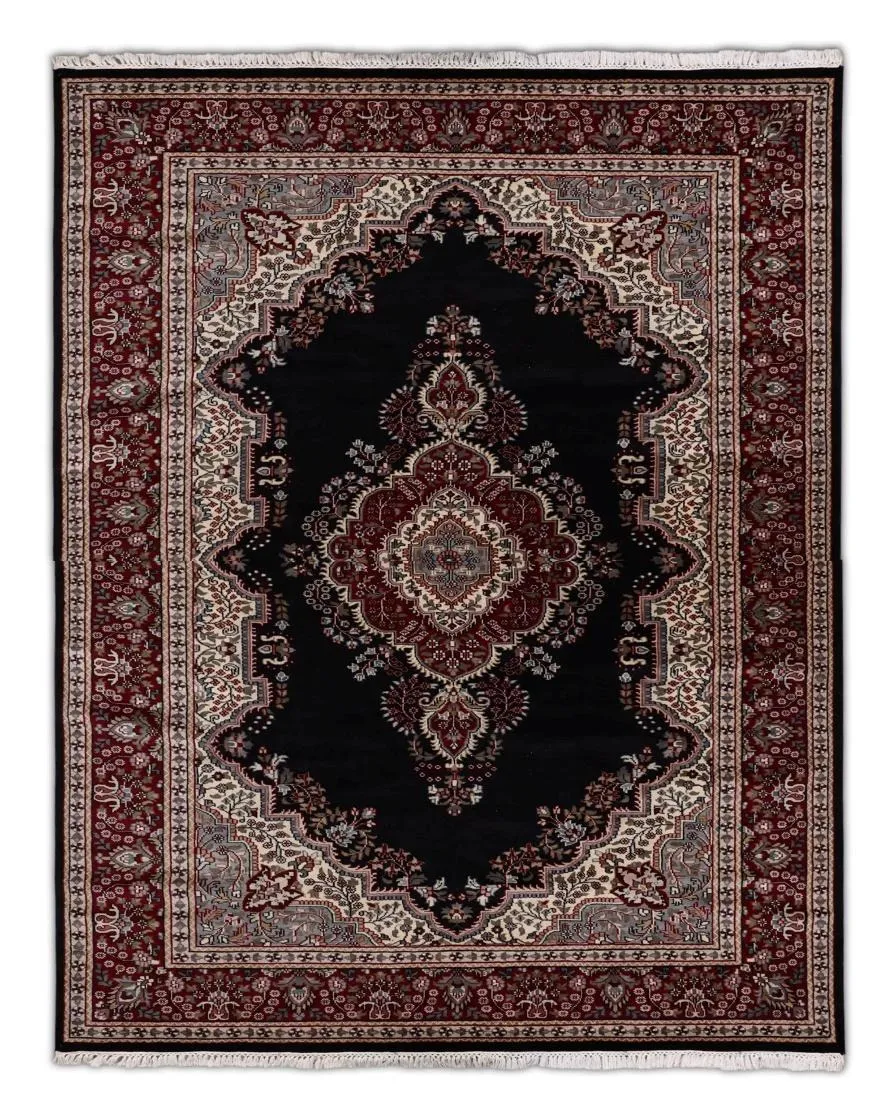
Whether you’re a rug connoisseur or simply someone who appreciates good craft Iranian silk rugs are hard to miss. The type sits among the finer end of home décor. The category is known for its history, level of detail, and the distinct sheen and softness that comes with silk.
If you’re considering bringing one home, it helps to approach the decision with a bit of thought. An Iranian silk rug is rarely something you choose in a single go. You tend to circle back to it. Look once, then again.
What stands out at first is usually the surface and what comes along with it – the sheen, the detail, the clarity of the pattern. But that isn’t what holds your attention over time. It’s the way the rug shifts. Silk responds to light in a way wool doesn’t. The same rug can appear deeper in tone from one angle, softer from another. That movement isn’t decorative. It’s inherent to the material that makes it quite popular amongst designers too. And to say that it’s often what makes you return to the same rug more than once wouldn’t be entirely wrong.
What Makes Iranian Silk Rugs Distinct
Not all handmade silk rugs are the same. With Iranian silk rugs, the difference usually comes down to precision. The threads are finer, which allows for tighter knotting. That, in turn, makes more intricate drawing possible.
You begin to see it in the detailing. Borders that feel sharper. Motifs that don’t blur into each other. The colours that don’t cut across each other but ease into one another more gradually.
Many of these traditional rugs were woven in regions like Qom or Isfahan. The regions were popular for their silk weaving which has been refined over decades. The designs often carry a certain discipline. Balanced, but not rigid.
Even today, when you explore our curation of Iranian Silk rugs, you will notice that nothing feels accidental. Our local artisans weave the same flair into each knot.
Looking Beyond the Surface
At a distance, most silk rugs appear refined. The real differences show when you move closer. Turn the rug over. The pattern should still be visible on the back, though less vivid. That clarity tells you the knots have been tied with care.
Run your hand across the surface. It shouldn’t feel loose or uneven. Handknotted silk rug has a certain firmness to it, even though the fibre itself is soft. It’s a small detail, but it often marks the difference between something that’s simply decorative and something that’s genuinely well made.
Where Silk Rugs Sit Best
Silk changes how a rug behaves in a space. It’s lighter than wool and reacts more to heavy footfall. The handmade piece of art is not fragile, to say, but be more selective where you layer them.. An Iranian silk rug tends to feel more at ease in spaces that are used a little more gently – a formal living room or a bedroom or even a study.
In areas with constant movement, the same qualities that make it refined can become a limitation. This isn’t something to decide later. Placement usually comes first. So, think beforehand placing the order of your Iranian silk rugs online.
The Difference Size Can Make
With handmade silk rugs, proportion matters more than expected. The detailing is often intricate, sometimes very fine.
In a smaller rug, that level of work can feel compressed. The pattern doesn’t have enough room to open up. In larger area rugs, the design breathes differently. Motifs become clearer. The rhythm of the pattern starts to settle.
At the same time, scale needs to respond to the room. A rug that extends too far can feel imposed. One that sits too tightly can feel contained.
Understanding the Cost
The price of an Iranian silk rug is rarely about material alone. Silk is expensive, but the larger factor is time. Each knot is tied by hand. In finer handmade rugs, the knot count can be extremely high, which allows for that level of detail but also extends the weaving process significantly. Months, sometimes longer. This is why these rugs tend to sit in a different category from most others. They are not made quickly. And they are not usually bought with short-term use in mind.
Authenticity Isn’t Always Obvious
With higher-value rugs, authenticity can be less straightforward than expected. A genuine handmade silk rug will not feel perfectly uniform. There may be slight variations in tone. Areas where the colour shifts subtly. These are not flaws. They come from natural dyeing and handwork.
The surface will also react to light. It may appear brighter or deeper depending on how it is viewed. These are the details that are easier to recognise once you’ve spent time looking.
Choosing from a source that focuses on craft helps here. Kesari Home offers a curated range of Iranian silk rugs, selected with attention to origin, material, and technique. That reduces much of the uncertainty that comes with a first purchase.
Why These Rugs Stay
An Iranian silk rug is rarely chosen for immediate impact alone. It tends to stay because it continues to reveal itself. The detailing, the way the surface shifts, the precision of the weave, these are not things that fade with familiarity. If anything, they become more noticeable over time. That’s what separates it from more temporary additions.
Final Thought
Buying your first rug online often comes with hesitation. That’s not a drawback. It usually means you’re looking thoroughly enough. Once you understand what you’re seeing, not just the pattern, but the structure behind it, the decision becomes clearer. Not simpler. But more certain. And that’s usually where a piece like this begins to make sense.